Skip to content

How to Choose Restaurant Chairs for Your Business?

Choosing Restaurant Chairs is a business decision, not merely a decoration exercise. A chair affects comfort, dining time, cleaning routines, and perceived value. The National Restaurant Association’s 2024 State of the Restaurant Industry Report projected U.S. restaurant sales at approximately $1 trillion. It also identified labor, operating costs, and customer experience as continuing priorities. In such a demanding market, furniture must support daily performance.

Look closely at real service conditions. A dining chair may be moved hundreds of times each week. Servers squeeze between tables. Guests spill sauces, drag bags, and sometimes lean back too far. Restaurant Chairs should therefore combine stable construction, cleanable surfaces, sensible weight, and suitable dimensions. BIFMA furniture performance standards can provide useful reference points for durability and safety, although compliance language should be verified with each supplier. A product description alone is not enough.

Comfort deserves measurable attention. The chair should support an upright posture without pressing sharply behind the knees. Seat height must work with the table, floor finish, and customer profile. Upholstery may look luxurious, but textured fabric can trap crumbs and cleaning moisture. Hard surfaces can simplify maintenance, yet they may feel cold and noisy. That trade-off is easy to underestimate.

The best choice depends on your service model. Fast-casual restaurants may value stackability and rapid turnover. Fine dining venues may prioritize cushioning, silence, and visual consistency. Outdoor locations need weather-resistant materials and reliable drainage. These are practical observations, not universal rules. A showroom test can still mislead you. Test sample chairs during a busy shift, then review comfort, wobble, cleaning time, and damage after several weeks. That evidence is more useful than attractive photographs.
How to Choose Restaurant Chairs for Your Business?

Define Your Restaurant’s Seating Needs and Service Style

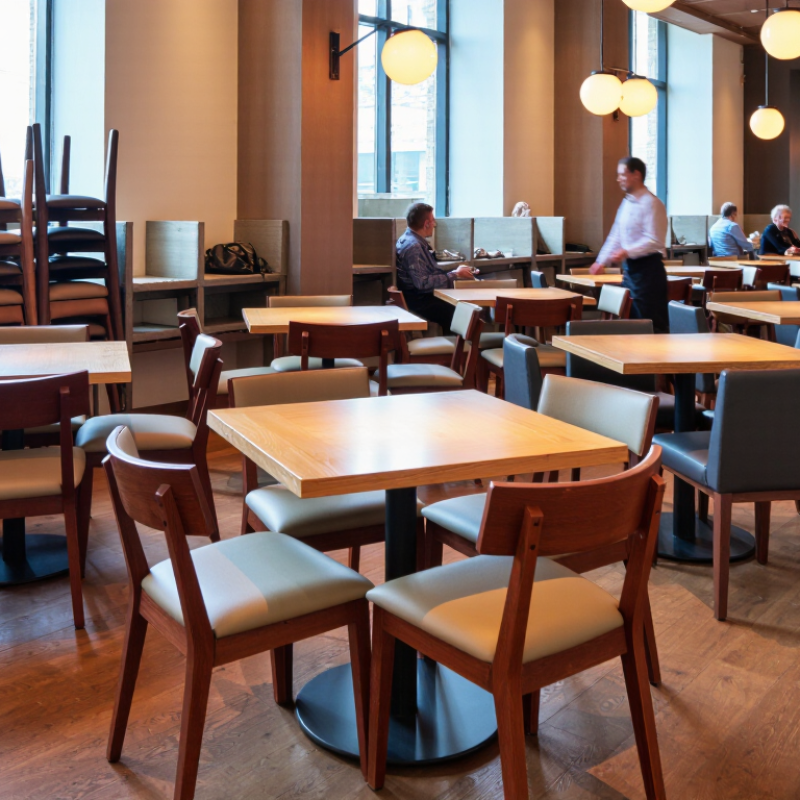
Before choosing restaurant chairs, define how guests actually use your dining room. A café serving quick breakfasts needs easy-to-move chairs and compact tables. A fine-dining room needs supportive seating for longer meals. Measure average dining time, table turnover, and peak occupancy. Walk through a busy service before ordering samples. Watch where servers squeeze past. Small details matter.

I once underestimated aisle width, and staff repeatedly bumped chair backs.

Your service style should guide chair height, weight, and maintenance needs. Counter-service venues may benefit from lightweight chairs that can be rearranged quickly. Full-service restaurants often need sturdier frames and generous back support. For outdoor or high-spill areas, choose surfaces that tolerate frequent cleaning and drying. Ask staff to sit for ten minutes. Their feedback reveals pressure points customers may notice later.

Comfort is not only a design preference; it affects how long guests stay and whether they return.

Create a seating map using real dimensions, including chair pull-back space. Test one complete table setting during lunch and dinner conditions. Check elbows, bags, mobility access, and server movement. Do not judge a chair from appearance alone. A beautiful seat can become tiring after an hour. Also, avoid assuming every customer has the same body size or comfort needs. Your first layout may look efficient but feel crowded. Revise it after observing real service for a week.

Assess Chair Materials, Durability, and Maintenance Requirements

Choosing restaurant chairs starts with the room’s daily pressure, not just its appearance. Solid wood adds warmth, while powder-coated metal handles frequent movement well. Molded plastic may suit patios and casual dining areas, but inspect its flexibility carefully. Sit on sample chairs for several minutes. Notice wobbling, sharp edges, and pressure points under the thighs. A chair that feels attractive for ten seconds may feel tiring during a two-hour meal.

Durability depends on joints, fasteners, surface protection, and the dining environment. Check whether frames are reinforced and whether replacement glides or screws are available. For upholstered seating, coated vinyl usually allows faster cleaning, while fabric can offer more comfort but absorb spills. Moisture near entrances can damage untreated wood and corrode exposed metal. I once underestimated how quickly loose screws appeared in a busy dining room. Low purchase prices can become expensive after repeated repairs. No material is maintenance-free.

Tips: Test chairs with real staff before ordering. Wipe sample surfaces with your planned cleaner and check for discoloration. Create a weekly inspection routine for loose joints, cracked finishes, and uneven feet. Keep a few spare chairs in storage. Cleaning guidance should come from the material supplier, because harsh chemicals may weaken coatings or upholstery. Reconsider your choice if maintenance feels unrealistic for your team.

How to Choose Restaurant Chairs for Your Business?

Comparing common restaurant chair materials by durability, cleaning ease, and repairability helps balance long-term performance with daily maintenance requirements. Scores use a practical 1–5 commercial-use scale, where 5 indicates the strongest performance.

Solid wood offers good repairability but may require regular refinishing. Powder-coated metal is highly durable and easy to clean, while molded plastic is lightweight and low-maintenance. Upholstered chairs provide comfort but need more frequent cleaning and fabric care.

Choose Chair Dimensions for Comfort, Space, and Accessibility

Selecting restaurant chairs starts with the room, not the catalogue. In a busy dining room, I measure table spacing with occupied chairs, not empty ones. A standard seat height of 17 to 19 inches suits many dining tables. Pair it with roughly 10 to 12 inches between the seat and tabletop. That gap lets knees move naturally.

Seat width matters too. I usually allow 18 to 20 inches per guest, before adding armrests. Wide chairs feel generous, but they can quietly reduce table capacity. Seat depth should support the thighs without pressing behind the knees. A practical range is 16 to 18 inches, though body sizes vary. Test chairs with staff and several customers before ordering hundreds.

Ask a shorter person to sit back, and ask a taller person to stand comfortably. This trial often exposes mistakes on a showroom floor. Cushion softness can mislead. A plush seat may feel pleasant for five minutes, then lose support during a long meal. Leave clear circulation paths between rows and near doors. Provide suitable spaces for mobility devices and maintain clear approach routes. Exact dimensions depend on local accessibility requirements, so verify them with a qualified professional. I once favored compact chairs to gain two extra covers per table. The room looked efficient, but guests moved awkwardly. That choice needed rethinking.

How to Choose Restaurant Chairs for Your Business? Choose Chair Dimensions for Comfort, Space, and Accessibility
Dimension or Factor Recommended Range Why It Matters Best Use or Planning Guidance Measurement Tip
Seat Height 17–19 in
(43–48 cm)
Supports a natural sitting posture and allows comfortable leg clearance beneath standard dining tables. Suitable for most dining chairs paired with tables approximately 28–30 in (71–76 cm) high. Measure from the floor to the highest point of the compressed seat cushion.
Seat Width 17–20 in
(43–51 cm)
Provides everyday comfort without using unnecessary floor space. Use wider seats of about 19–22 in (48–56 cm) where guest comfort or longer dining times are priorities. Measure the usable space between the arms, or the full seat width on armless chairs.
Seat Depth 16–18 in
(41–46 cm)
Helps support the thighs while allowing shorter guests to keep their feet comfortably on the floor. Choose a shallower seat for fast-service restaurants and a deeper seat for relaxed, longer-duration dining. Measure from the front edge of the seat to the back cushion, excluding any unusable curved areas.
Backrest Height 12–20 in
(30–51 cm) above the seat
Affects lumbar support, visual openness, stacking capability, and the perceived atmosphere of the room. Lower backs suit compact or visually open layouts; higher backs provide more support for extended dining. Check both the back height and its angle; excessive recline can increase the chair footprint.
Armrest Height 7–9 in
(18–23 cm) above the seat
Can improve support and comfort but may prevent chairs from sliding under tables. Select armless chairs for tight layouts; use arms where comfort and a premium seating experience are priorities. Confirm that the armrests fit below the tabletop, apron, or counter edge.
Chair Width Allowance 24–30 in
(61–76 cm) per diner
Prevents guests from feeling crowded and provides enough room to pull out and use a chair. Allow more space for chairs with arms, broad seats, or high-turnover areas where guests need easier movement. Plan using the chair’s widest point, including arms, legs, and any side projection.
Table-to-Seat Relationship 10–12 in
(25–30 cm) from seat top to tabletop
Creates practical legroom and keeps the dining surface at a comfortable height. Test the actual chair and table together because cushion compression and table aprons can reduce usable clearance. Measure from the compressed seat surface to the underside of the tabletop, not only to the tabletop edge.
Table Leg and Apron Clearance At least 24 in
(61 cm) knee width per diner
Allows guests to sit down, change posture, and leave without striking table supports. Pedestal or trestle bases may provide more flexible seating than tables with legs at every corner. Check clearance at both seated knee height and foot level, especially with fixed benches.
Pull-Out and Service Clearance 30–36 in
(76–91 cm) behind a seated diner
Supports chair movement, staff circulation, cleaning, and safer guest access. Use the larger allowance in primary aisles, busy service paths, and areas where chairs are frequently pulled out. Measure from the table edge to the nearest wall, furniture, or circulation obstacle.
Accessible Route Width At least 36 in
(91 cm) clear route
Helps accommodate wheelchair users and improves movement for guests using mobility aids. Keep the route free from chair legs, display stands, bags, and service equipment; verify local accessibility requirements. Measure the unobstructed floor width at the narrowest point, not the nominal aisle width.
Wheelchair Seating Space At least 30 × 48 in
(76 × 122 cm) clear floor area
Provides a practical space for a wheelchair beside or within the dining layout. Include accessible positions at different table types and avoid using them as storage or temporary chair spaces. Confirm that the table provides usable knee clearance and does not rely on movable chairs blocking the approach.
Chair Stability and Load Rating Commercial-grade construction; verify tested load rating Reduces safety risks and supports frequent use, cleaning, and repeated movement. Request documented testing, inspect joints and glides, and select finishes designed for the restaurant’s usage level. Evaluate the complete chair, including casters, glides, fasteners, frame, and upholstery—not only the seat material.
Stacking and Storage Height 4–8 chairs per stack, if stacking is required Makes floor cleaning, event reconfiguration, and off-peak storage more efficient. Choose stackable chairs only when the frame remains stable and the finish will not be damaged during handling. Measure the complete stacked height and allow additional clearance for safe lifting and storage access.
Planning note: The dimensions above are practical starting points for restaurant layouts. Always test a full-size chair sample with the intended table, flooring, circulation pattern, and accessibility requirements before placing a large order. Local building and accessibility regulations may require different clearances.

Match Chair Design With Your Restaurant’s Interior and Brand

How to Choose Restaurant Chairs for Your Business?

Chair design should speak the same visual language as your restaurant. A soft, curved chair suits a relaxed dining room. A straight wooden chair feels more practical and informal. Match its color, texture, and shape with your logo, lighting, tables, and wall finishes. The 2024 State of the Restaurant Industry report from the National Restaurant Association projected restaurant sales above $1 trillion in the United States. That scale reflects intense competition. A recognizable interior can help customers remember the experience, not just the meal.

Look closely at the customer journey. Place a compact chair beside a narrow two-person table. Use deeper upholstered seating in comfortable lounge areas. The seat should support the body without making guests feel trapped. According to the 2023 Global Consumer Insights Pulse Survey from PwC, consumers continue to value experience when choosing where to spend. Design therefore needs to work beyond photographs. In practice, I would test chairs for two busy weeks before ordering widely. Check wobbling, fabric marks, cleaning time, and staff movement. Small failures become expensive quickly. A visually perfect chair may still damage the brand if it scratches floors or slows table turnover. I would also question trend-driven choices. A fashionable color can age badly, while a quiet material may support the concept longer. The best match is not always the most dramatic one.

Compare Costs, Safety Standards, Suppliers, and Long-Term Value

Choosing restaurant chairs requires more than comparing showroom prices. The National Restaurant Association’s 2024 State of the Restaurant Industry Report projected U.S. restaurant sales above $1 trillion, while labor and operating costs remain major pressures. A chair costing $45 may seem attractive, but replacement, delivery, cleaning, and downtime can quickly change its value.

I inspect the frame joints, welds, seat attachment, and floor glides before approving a purchase. Ask suppliers for test reports covering strength, durability, and stability. EN 16139 is a useful reference for non-domestic seating, although requirements vary by market. Upholstery should resist repeated wiping, moisture, and food stains. Safety paperwork matters.

Not every “commercial” chair performs equally.

Compare supplier evidence, not promises. Request sample units, warranty terms, spare-part availability, carton dimensions, and lead times in writing.

The U.S. Bureau of Labor Statistics reported that accommodation and food services had more than 14 million jobs in 2023, showing how heavily these chairs may be used each day. A busy dining room can expose weak fasteners within months.

I would calculate cost per service year, not cost per chair. For example, a $90 chair lasting six years costs less annually than a $55 chair lasting two years. This estimate is imperfect. Cleaning chemicals, uneven floors, and careless stacking can shorten both lifespans. Check ten sample chairs before ordering hundreds, and record defects with dated photographs.

Scroll To Top