
China Best Outdoor Flags Manufacturer and Supplier?
Choosing the best China Outdoor Flags manufacturer requires more than comparing prices. A reliable supplier should combine fabric knowledge, stable production, accurate color control, and practical delivery experience. Outdoor flags face strong sunlight, rain, dust, and repeated wind movement. Low-quality polyester may fade quickly or tear around the stitching.
Whitney Smith, founder of the Flag Research Center and a respected flag scholar, said, “A flag is not merely a piece of cloth; it is a symbol.” That idea still matters in commercial flag production. The printed logo must remain recognizable from a distance. The hem should feel firm in the hand. Metal eyelets, reinforced corners, and suitable pole systems can prevent early failure.
A strong Chinese manufacturer should explain these details clearly. It should offer sample approval, fabric options, color references, production photos, and realistic lead times. Certifications and quality records also deserve careful checking. A polished website is not enough.
Experience matters here.
Buyers should ask how the supplier handles uneven wind loads, custom shapes, and outdoor storage. They should also confirm packaging methods, replacement policies, and inspection procedures before payment. No manufacturer gets every decision right. Even experienced buyers sometimes choose a cheaper fabric and regret it after one season.
This guide examines production capability, material performance, customization, pricing, and export reliability. It aims to help importers identify a dependable China Outdoor Flags partner, not simply the lowest quotation. A good supplier protects both visibility and budget. That balance is harder than it looks.
What Defines an Outdoor Flag: Types, Fabrics, GSM, and Use Cases
What Defines an Outdoor Flag: Types, Fabrics, GSM, and Use Cases
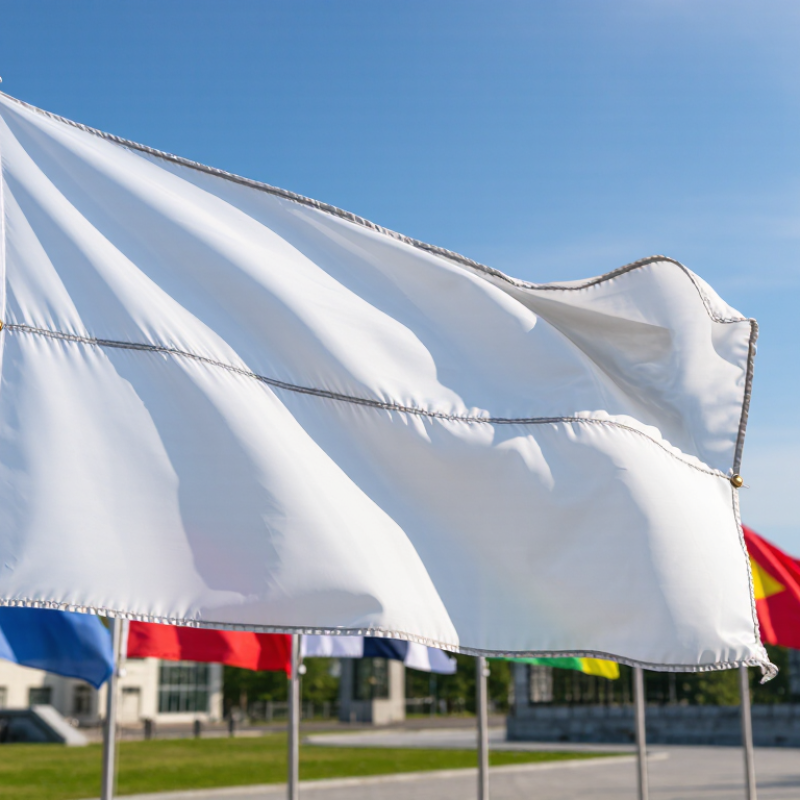
An outdoor flag must stay visible through changing weather, not just look attractive on a product page. Common types include feather flags, teardrop flags, square flags, and rectangular banner flags. Feather shapes catch attention near entrances, while teardrop designs often remain readable in uneven wind. Rectangular flags suit poles, fences, public events, and temporary outdoor displays. Shape affects movement, printing space, and installation requirements.
Fabric choice matters as much as design. Knitted polyester, usually around 110–120 GSM, offers airflow and a soft drape. Woven polyester feels firmer and can support sharper details. Heavier fabric is not automatically better. It may resist tearing, but it can place more stress on poles and stitching. UV-resistant ink, double-stitched edges, reinforced corners, and a strong sleeve improve practical service life. A flag can still fade when exposed to intense sunlight for months.
In production checks, I inspect seams, eyelets, fabric recovery, and print alignment before shipment. Small defects often appear after repeated wind movement, not during a showroom inspection. That part deserves more attention. Outdoor flags work at sports grounds, roadside businesses, festivals, construction entrances, and community gatherings. For windy locations, choose a flexible frame, breathable fabric, and a secure ground base. For short campaigns, a lighter 90–110 GSM option may reduce cost, although its lifespan can be shorter. Local weather should guide the specification.
China Best Outdoor Flags Manufacturer and Supplier? – What Defines an Outdoor Flag: Types, Fabrics, GSM, and Use Cases
| Outdoor Flag Type | Typical Shape and Structure | Common Fabric | Typical Fabric Weight (GSM) | Wind Behavior | Recommended Finishing | Typical Outdoor Use Cases |
|---|---|---|---|---|---|---|
| Feather Flag | Tall, curved flag mounted on a flexible vertical pole; the graphic follows the pole and remains partially visible when the wind changes. | Knitted polyester | 110–130 | Moves freely in light to moderate wind; the flexible pole reduces direct wind load. | Sewn sleeve, reinforced pole pocket, webbing, and durable attachment loops. | Retail entrances, exhibitions, sports events, hospitality areas, and roadside promotions. |
| Teardrop Flag | Rounded top with a tapered lower section; a tensioned pole keeps the fabric stretched around the frame. | Knitted polyester | 110–130 | Generally stable in light to moderate wind; the compact shape can present less surface area than a rectangular flag. | Full-perimeter sleeve, reinforced bottom corner, and compatible ground base. | Trade shows, outdoor registration points, cafés, golf events, and temporary campaigns. |
| Rectangular Pole Flag | Traditional rectangular panel fixed to a vertical pole, with a horizontal header or side attachment depending on the mounting system. | Woven polyester or knitted polyester | 115–160 | Suitable for moderate wind when correctly mounted; larger panels require stronger poles and secure anchoring. | Double-stitched hems, header tape, rope and toggle, D-rings, or webbing loops. | Permanent flagpoles, public facilities, campuses, venues, offices, and ceremonial areas. |
| Banner Flag | Wide horizontal or vertical fabric panel designed for poles, fences, railings, or event structures. | Woven polyester, knitted polyester, or polyester mesh | 115–180 | Solid fabric creates higher wind load; mesh construction improves air passage in exposed locations. | Reinforced hems, eyelets, webbing, rope pockets, or perimeter sleeves. | Fence branding, construction sites, festivals, stadiums, parades, and temporary barriers. |
| Pennant String | A series of triangular or rectangular fabric pieces attached along a cord or tape. | Knitted polyester or lightweight woven polyester | 80–120 | Low individual panel weight, but the cord and anchor points must be secured against gusts. | Double-folded top tape, reinforced cord ends, and bartacked stress points. | Outdoor celebrations, markets, school events, festivals, and decorative installations. |
| Mesh Flag or Banner | Open-weave fabric panel that allows air to pass through more easily than solid fabric. | Polyester mesh | 115–160 | Better suited to windy or exposed sites because the open structure reduces wind resistance. | Reinforced perimeter, webbing, eyelets, and closely spaced attachment points. | Coastal locations, bridges, building fences, construction zones, and high-wind installations. |
| Double-Sided Flag | Two printed fabric faces separated by an opaque or blockout layer to reduce image show-through. | Blockout polyester or two fabric panels with an internal liner | 220–300 | Heavier than single-layer flags; requires stronger hardware and careful anchoring in windy conditions. | Closed hems, internal liner, reinforced corners, and heavy-duty pole or bracket fittings. | Street-level wayfinding, public information, premium displays, and locations requiring readable graphics on both sides. |
| Ceremonial or Institutional Flag | Formal rectangular flag intended for vertical poles, indoor-outdoor ceremonies, or long-term display. | Woven polyester, spun polyester, or durable nylon | 120–200 | Performance depends on size, pole height, fabric, and local weather; should be lowered during severe conditions. | Heavy-duty heading, rope and toggle, reinforced fly end, and double-stitched perimeter. | Government buildings, schools, memorials, institutions, ceremonies, and civic spaces. |
| Specification note: GSM means grams per square metre and indicates fabric mass, not automatic quality. The ranges shown are common commercial specifications and may vary by yarn, weave, coating, print method, sewing design, flag size, and supplier. Actual wind suitability depends on the complete system, including fabric porosity, pole strength, base type, anchoring, installation height, and local weather conditions. | ||||||