China Best 50W Explosion Proof High Bay Hood Supplier?
Choosing a China-based supplier for a 50W explosion-proof high bay hood begins with the operating environment, not the catalogue photograph. A dusty paint room, a grain-handling area, and a chemical plant can demand different protection and installation details. The phrase xplosion-proof high bay hood 50w may describe a product search, but it does not confirm suitability. Buyers should check the actual product marking, photometric files, enclosure materials, operating temperature range, and applicable certification documents.
Energy performance also deserves careful scrutiny. The U.S. Department of Energy’s LED lighting guidance reports that LEDs use at least 75% less energy and can last up to 25 times longer than incandescent lighting. That comparison is a broad benchmark, not a promise for every 50W fixture or site. Ask suppliers for measured efficacy, lumen output, beam distribution, and test conditions. A bright central pool with dark aisles is still poor lighting. Small detail, big difference.
For a fair supplier comparison, request a complete datasheet, sample test reports, warranty terms, and evidence that the supplied model matches its certified configuration. Check production quality controls and replacement-part availability, too. These checks reflect practical sourcing experience; they are not a substitute for a qualified site assessment. A low purchase price can look convincing. Yet missing documentation, unclear ratings, or inconsistent batch quality may create costly delays. No single supplier is “best” for every project. The strongest choice is the one that can substantiate its claims and answer technical questions clearly.
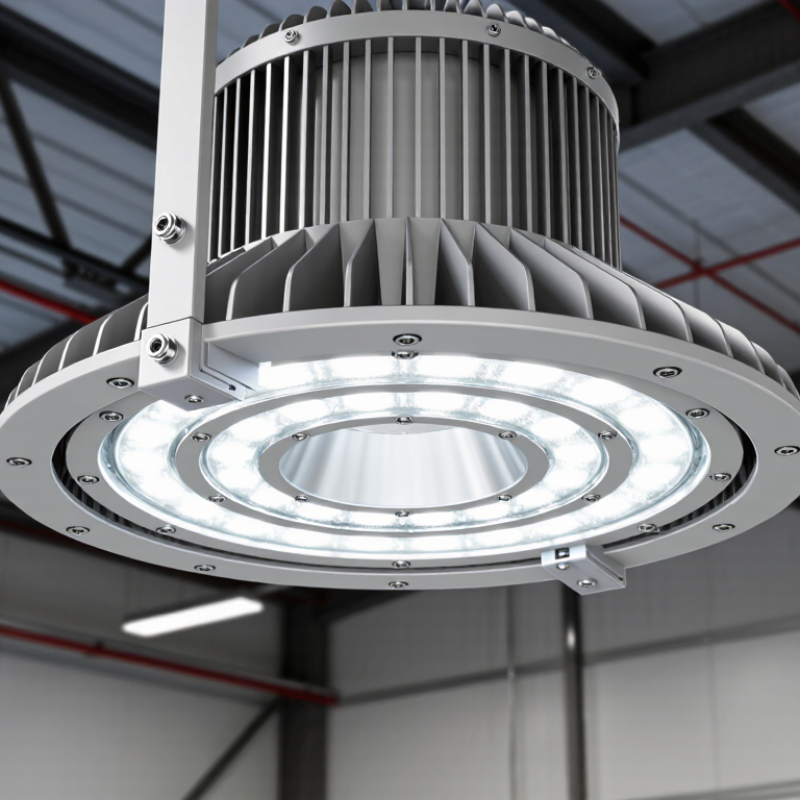
Defining 50 W Explosion-Proof High-Bay Hoods and Their Rated Input Power
A 50 W explosion-proof high-bay hood is a high-mounted lighting assembly specified to draw 50 watts of electrical power under stated operating conditions. The figure describes rated input power, not the amount of light reaching the floor. Not the same thing. Actual brightness depends on factors such as LED efficiency, optics, and installation height.
Check the nameplate and product data for the rated voltage, frequency, input current, and operating temperature range. A driver can affect power use, while a hood or reflector can shape the beam and reduce glare. The explosion-protection design is a separate specification; the hood alone does not prove the complete fixture is suitable for a hazardous location. Verify the assembly’s certification and markings for the intended environment.
A common weakness in comparisons is treating 50 W as a brightness guarantee. It is not. When assessing a supplier, compare measured light output, beam distribution, materials, and test documentation alongside input power. A clear datasheet should state test conditions, because figures without context can be misleading. Even careful specifications leave a practical question: will the light cover the actual work area without dark corners?
Classifying Hazardous Areas: Gas Zones 1/2 and Dust Zones 21/22
A 50W explosion-proof high-bay hood should match the hazardous-area classification, not just the room’s appearance. Gas Zone 1 means an explosive gas atmosphere may occur during normal operation; Zone 2 means it is unlikely, and usually brief if it occurs. Dust Zone 21 allows for occasional explosive dust clouds during normal operation. Zone 22 describes clouds that are unlikely and brief. These distinctions affect the equipment’s required protection.
Check the product marking against the site’s gas or dust group, temperature limits, and ambient conditions. Also confirm the installation height, mounting method, and required ingress protection. A compact 50W fitting may suit a small processing bay, but wattage alone says little about coverage or safety. Ask the supplier for current test documentation and clear installation instructions. A label is not enough. I would also compare the marked temperature limit with the actual dust ignition risk; this detail is easy to overlook.
Tips: Confirm the zone with a qualified site assessment before ordering. Keep the hazardous-area drawings and equipment markings together. If the classification is uncertain, pause and verify it rather than guessing. Even a careful checklist can miss a site-specific condition.
China Best 50W Explosion Proof High Bay Hood Supplier? - Classifying Hazardous Areas: Gas Zones 1/2 and Dust Zones 21/22
Use the hazardous-area classification established for the installation to determine the required luminaire certification. A 50 W rating or a hood design alone does not establish suitability for a hazardous location.
| Area classification | Hazardous atmosphere | Zone description | Key luminaire checks |
| Zone 1 | Flammable gas, vapour, or mist | An explosive gas atmosphere is likely to occur occasionally during normal operation. | Confirm certification covers Zone 1, the site’s gas group and temperature class, and the installation’s ambient-temperature range. |
| Zone 2 | Flammable gas, vapour, or mist | An explosive gas atmosphere is not likely to occur during normal operation; if it does occur, it is expected to persist only for a short time. | Check that the certificate explicitly covers Zone 2 and the applicable gas group, temperature class, and ambient conditions. |
| Zone 21 | Combustible dust cloud | An explosive dust atmosphere in the form of a cloud is likely to occur occasionally during normal operation. | Confirm dust-zone certification, dust group, maximum surface temperature, and suitability for the site’s dust conditions. |
| Zone 22 | Combustible dust cloud | An explosive dust atmosphere in the form of a cloud is not likely to occur during normal operation; if it does occur, it is expected to persist only for a short time. | Check the certificate’s Zone 22 scope, dust group, maximum surface temperature, and ambient-temperature limits. |
Selection checklist for a 50 W high-bay luminaire
| Selection item | What to verify |
| Hazardous-area certificate | The certificate and marking must match the classified zone and the applicable gas or dust hazard. Do not infer approval from wattage, appearance, or the term “explosion proof.” |
| Gas or dust properties | For gas hazards, check the required gas group and temperature class. For dust hazards, check the dust group and maximum permitted surface temperature against the site assessment. |
| Ingress protection and enclosure | Verify the declared IP rating and enclosure construction for the actual dust, moisture, cleaning, and outdoor exposure conditions. An IP rating alone does not certify equipment for an explosive atmosphere. |
| Electrical and installation details | Confirm rated supply voltage and frequency, cable entries, mounting method, operating ambient range, and installation requirements against the product documentation and site design. |
| Photometric suitability | Review verified lumen output, beam distribution, mounting height, and lighting calculations for the task. A 50 W rating by itself does not specify light output or illuminance. |
Zone definitions are based on the likelihood and duration of an explosive atmosphere. The responsible area-classification assessment and the luminaire’s current certification documentation should determine final product selection and installation.
Reading Equipment Markings: IEC 60079, Temperature Class, and IP Code
Reading Equipment Markings: IEC 60079, Temperature Class, and IP Code
A 50W rating describes electrical power, not hazardous-area suitability. Check the complete nameplate before selecting an explosion-protected high-bay hood. IEC 60079-0:2017 sets general equipment requirements and marking conventions for explosive atmospheres. Its temperature classes provide clear limits: T1 permits a maximum surface temperature of 450°C, while T6 limits it to 85°C. Lower surface temperatures matter where nearby gases or vapors can ignite at relatively low temperatures. Read the full marking, including gas group and protection concept. Small print matters.
The IP code answers a different question. Under IEC 60529, the first digit rates protection against solid objects; the second rates protection against water ingress. For example, IP66 indicates dust-tight construction and resistance to powerful water jets under specified test conditions. It does not prove explosion protection. Nor does a high IP rating make a fitting suitable for every chemical, washdown practice, or outdoor site. Match the certificate and nameplate to the actual area classification, ambient temperature, and mounting conditions. IEC values describe standardized tests, not guaranteed service life. That distinction is easy to miss. A supplier’s datasheet should show the exact marking and certificate scope, not just “50W” and “explosion proof.” Verify the details with a qualified hazardous-area professional before installation.
Reading Explosion-Proof Lighting Markings
IEC 60079 temperature classes define the maximum equipment surface temperature. The chart shows the limits for each class.
How to read it: T6 has the lowest maximum surface temperature (85°C), while T1 has the highest (450°C). Choose equipment whose marked maximum surface temperature is below the ignition temperature of the hazardous atmosphere, following the applicable installation rules.
IP code: The first digit indicates protection against solid ingress and the second against water ingress. For example, IP66 is dust-tight (6) and protected against powerful water jets (6). An IP rating does not replace explosion-protection certification.
Comparing China Suppliers: IECEx/ATEX Documents and 50 W Photometric Data
China Best 50W Explosion-Proof High Bay Hood Supplier?
When comparing Chinese suppliers, request the IECEx certificate and ATEX documentation for the exact luminaire model—not a similar product family. Check model codes, protection marking, ambient-temperature limits, and certificate status against the issuing scheme’s records. IEC 60079 series requirements address equipment for explosive atmospheres, but a document alone does not confirm that a supplier’s current production matches the certified design. Ask for traceable production and inspection records.
For photometry, request the complete IES LM-79-19 test report from an accredited laboratory, not only a catalog lumen figure. It should identify input power, measured light output, distribution, CCT, and CRI. For example, 6,000 measured lumens at 50 W equals 120 lm/W; this is a calculation, not a promised benchmark. Compare the report’s beam data with mounting height and target area. A broad hood can spread light differently from a narrow reflector. One detail I would double-check: whether the report covers the exact hood and driver combination offered.
Tips: Match certificate and photometric report model numbers. Confirm test date, laboratory, and operating temperature. If a supplier cannot explain a sharp gap between catalog and measured output, pause and ask for clarification.
Matching Applications to Verified Lumen Output, Ambient Limits, and Mounting Height
A 50W explosion-proof high bay hood should be selected by measured light output, not wattage alone. Ask for verified lumen data and a photometric file showing how light spreads across the floor. A narrow beam may suit a tall, focused work area, while wider coverage can reduce dark gaps between fixtures. Check the intended mounting height against the lighting layout. Small details matter.
Ambient limits need equal attention. Compare the fixture’s stated operating range with actual conditions near the ceiling, where heat can build up. Confirm that its protection rating and installation details match the site’s classified area; a product description alone is not enough. For a 6-meter mounting height, for example, review beam distribution and target light levels before fixing spacing. If measured results differ from the plan, adjust the layout rather than assuming the 50W rating will compensate.
Tips: Request test documents, installation instructions, and the exact lumen value for the chosen configuration. Check mounting height, spacing, and ambient temperature together. Do not guess. A quick on-site light reading after installation can reveal uneven coverage, and it may show that the original assumptions were too optimistic.