
Choosing the best Wood Panels from China requires more than comparing prices. Product labels can look similar, yet their performance may differ greatly. Core density, adhesive quality, moisture resistance, surface finish, and formaldehyde emissions all deserve careful review.
Dr. Robert J. Ross, a respected wood-products researcher, once noted, “Wood is renewable, but responsible selection still matters.” This principle fits Chinese manufacturing well. China produces plywood, MDF, particleboard, OSB, and laminated panels at many quality levels. A reliable supplier should provide clear technical data, stable production records, and test reports from recognized laboratories. Factory experience matters too. A clean pressing line, organized veneer storage, and sealed panel edges can reveal more than polished catalog images.
The best choice depends on the project. Furniture makers may prioritize smooth sanding and screw-holding strength. Interior contractors may need low emissions and consistent thickness. Export buyers should also check packaging, moisture protection, and inspection procedures before shipment. Small details matter. A warped panel can damage an entire installation.
Still, no buying guide can remove every uncertainty. Test samples may perform differently after long storage or humid transport. Supplier claims should therefore be verified through independent inspection and practical trials. I have found that the cheapest panel is rarely the least expensive option after rework, waste, and delays. This article examines China’s leading Wood Panels categories, their strengths, limitations, and the questions buyers should ask before placing an order.
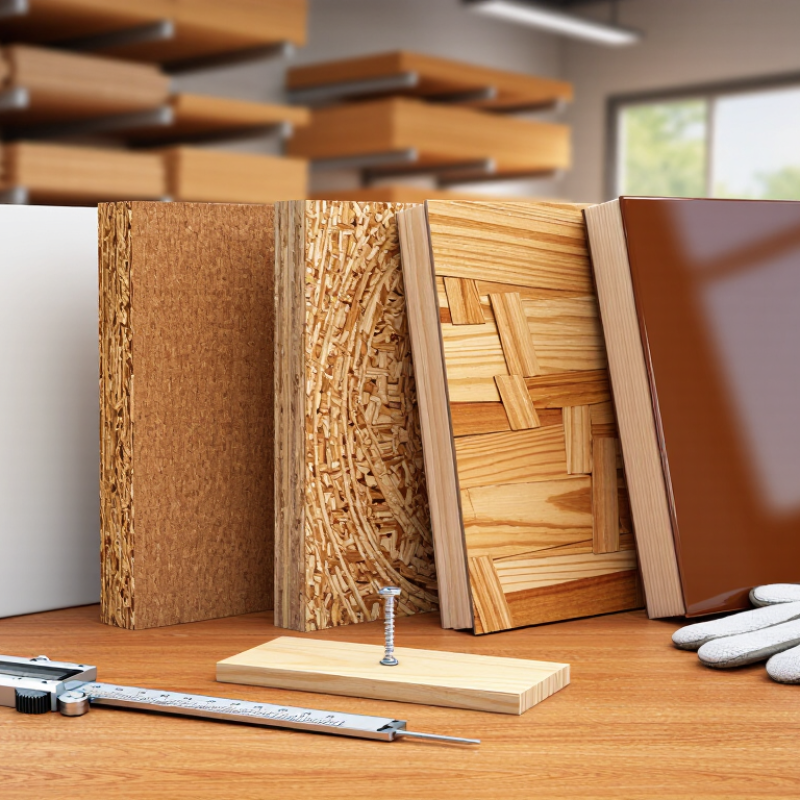
China supplies several wood panel types, each suited to different construction and furniture needs. In factory inspections, plywood often stands out for its strength and dimensional stability. Its cross-laminated veneers resist splitting and support repeated fastening. It performs well in cabinets, wall panels, and structural applications. However, veneer quality can vary between the panel core and surface layers. Inspect the edges, not only the polished face.
Medium-density fiberboard offers a smooth surface for painting, routing, and decorative shaping. It feels smooth. Standard MDF is economical but can swell after prolonged water exposure. Moisture-resistant MDF performs better in kitchens and humid rooms, though it still needs sealed edges. Particle board uses compressed wood particles and usually costs less. It works for indoor furniture but may hold screws less firmly after repeated assembly. Moisture changes everything.
Oriented strand board contains aligned wood strands and provides useful strength for walls, flooring, and packaging structures. Its visible texture may not suit refined interior finishes. For each panel, buyers should verify thickness tolerance, density, formaldehyde emissions, moisture resistance, and applicable test reports. Ask for production samples and compare weight, edge bonding, and flatness. A practical mistake is judging quality by appearance alone. Some attractive surfaces hide weak cores or uneven glue distribution. Clear specifications reduce that risk, but they do not replace independent inspection.
What Are the Best Wood Panels from China?
How Wood Panels from China Are Manufactured and Graded
Wood panels from China begin with carefully selected logs, veneers, or wood fibers. Manufacturers remove bark, reduce moisture, and sort materials by density and appearance. Drying is critical. Uneven moisture can cause swelling, warping, or weak bonding later.
Plywood production uses thin veneers arranged across changing grain directions. Particleboard and medium-density fiberboard use refined wood particles or fibers. Adhesive is added before hot pressing forms a stable panel. Workers then trim, sand, and inspect each sheet. I look closely at edges, because poor compression often appears there first.
Grading usually considers surface quality, core construction, thickness tolerance, moisture content, and bonding strength. Face and back grades may differ significantly. A clear face can hide internal gaps. That is an important weakness.
Reliable buyers request laboratory reports for formaldehyde emissions, bending strength, and dimensional stability. They should also confirm the testing method and production date. Visual inspection alone is not enough. Samples can pass easily. Large shipments may behave differently.
Panel grades are not perfectly uniform across every supplier. Terms such as commercial, furniture, or structural grade may lack consistent meaning. Specifications must be written clearly, including thickness, tolerance, wood species, adhesive type, and acceptable defects. A factory audit, sample comparison, and independent inspection provide stronger evidence than a catalog image.
| Panel Type | Main Material | Typical Manufacturing Process | Common Thicknesses | Typical Applications | Key Quality Indicators |
|---|---|---|---|---|---|
| Plywood | Rotary-cut or sliced wood veneers | Veneers are dried, assembled with alternating grain directions, bonded, hot-pressed, trimmed, sanded, and graded. | 3–25 mm | Furniture, cabinetry, interior construction, packaging, and concrete formwork. | Number of plies, veneer defects, core gaps, bonding strength, thickness tolerance, moisture content, and formaldehyde emission. |
| Medium-Density Fibreboard (MDF) | Refined wood fibres, wax, and resin | Wood is chipped, refined into fibres, blended with additives, formed into a mat, hot-pressed, cooled, sanded, and cut. | 2.5–30 mm | Painted furniture, cabinet components, moulded doors, wall panels, and routed decorative parts. | Density profile, surface smoothness, internal bond strength, screw-holding capacity, thickness swelling, and emission level. |
| Particleboard | Wood chips, shavings, and recycled wood particles | Particles are screened by size, dried, resin-coated, formed into layers, hot-pressed, cooled, sanded, and finished. | 6–40 mm | Ready-to-assemble furniture, shelving, office furniture, and laminated panels. | Face and core particle structure, internal bond, bending strength, screw withdrawal, thickness swelling, and edge integrity. |
| Oriented Strand Board (OSB) | Long, thin wood strands | Strands are dried, coated with resin, oriented in cross-directional layers, hot-pressed, trimmed, and graded. | 6–25 mm | Structural sheathing, flooring substrates, roof decking, packaging, and furniture components. | Strand orientation, bending strength, dimensional stability, internal bond, edge quality, moisture resistance, and surface defects. |
| Laminated Veneer Lumber (LVL) | Thin veneers with predominantly parallel grain | Veneers are dried, graded, bonded with aligned grain, continuously or batch pressed, sawn, and strength-graded. | Typically 25–75 mm | Beams, headers, furniture components, door cores, pallets, and engineered structural parts. | Veneer quality, grain alignment, glue-line performance, bending strength, modulus of elasticity, and dimensional accuracy. |
| Finger-Jointed Board | Solid-wood strips or plantation timber | Defects are removed, strips are finger-jointed, edge-glued or laminated, sanded, and inspected. | 12–30 mm | Furniture panels, shelving, tabletops, doors, and interior joinery. | Wood species, moisture content, joint strength, knot and resin-pocket limits, flatness, glue-line appearance, and surface grade. |
| Inspection Dimension | What Is Checked | Why It Matters | Typical Verification Method |
|---|---|---|---|
| Dimensions and Tolerances | Length, width, thickness, squareness, straightness, and flatness. | Accurate dimensions reduce cutting waste and installation problems. | Calipers, steel tapes, straightedges, and calibrated measuring tables. |
| Moisture Content | Moisture level at the time of production and shipment. | Improper moisture can cause swelling, shrinkage, warping, or bond failure. | Oven-dry testing or calibrated electrical moisture meters. |
| Mechanical Performance | Bending strength, modulus of elasticity, internal bond, and screw-holding strength. | Confirms whether the panel is suitable for load-bearing or furniture use. | Laboratory bending, tensile, internal-bond, and screw-withdrawal tests. |
| Surface and Appearance Grade | Knots, splits, holes, core gaps, patches, sanding marks, blisters, and color variation. | Determines whether the panel is appropriate for exposed, painted, laminated, or structural applications. | Visual inspection under controlled lighting and documented defect limits. |
| Bonding and Durability | Glue-line integrity, delamination resistance, thickness swelling, and water resistance. | Helps match the panel to dry, humid, or exterior service conditions. | Soak tests, cyclic humidity tests, delamination tests, and thickness measurements. |
| Formaldehyde Emission | Emission level from the finished panel and its surface treatment. | Important for indoor air quality and regulatory compliance. | Desiccator, perforator, or chamber testing according to the required standard. |
| Classification | Formaldehyde Emission Limit | General Interpretation | Typical Selection Consideration |
|---|---|---|---|
| E1 | ≤ 0.124 mg/m³ in the 24-hour climate-chamber method | The commonly recognized indoor-use limit under the relevant Chinese standard framework. | Confirm the test method, report date, and destination-market requirements. |
| E0 | ≤ 0.050 mg/m³ in the 24-hour climate-chamber method | A lower-emission classification than E1. | Often specified for enclosed indoor spaces where lower emissions are preferred. |
| ENF | ≤ 0.025 mg/m³ in the 24-hour climate-chamber method | A very-low-emission classification under the Chinese grading system. | Request an accredited laboratory report and verify that the classification applies to the exact panel construction. |
China produces a wide range of wood panels, each suited to different performance demands. Plywood offers strong screw holding and good dimensional stability. It works well for furniture, doors, flooring bases, and structural interiors. Oriented strand board provides efficient strength for walls, roofs, and packaging. Medium-density fiberboard gives smooth surfaces for painted cabinets and decorative components. However, it absorbs moisture quickly unless properly sealed. No panel wins every test.
Sustainability requires more than checking whether timber is “wood-based.” Ask for species information, recycled content, formaldehyde test results, and chain-of-custody documents. Certifications such as FSC or PEFC can support responsible sourcing, but documents still need independent verification. Manufacturing energy, resin type, transport distance, and panel lifespan also affect the environmental impact. A thinner panel may save material, yet fail earlier and create more waste. That trade-off deserves honest review. Product data sheets can look precise, but factory consistency may vary between batches.
Tips: Compare panels under the conditions they will face. Test screw holding, bending strength, moisture resistance, and surface quality. Request samples from more than one production batch. Check emission performance against the destination market’s requirements. For interior projects, inspect edges after cutting; weak bonding often appears there first. Do not choose solely by price. A slightly higher-grade panel may reduce repairs, replacements, and installation delays.
Chinese wood panels should be judged by measurable performance, not surface appearance. FAO’s Forestry Production and Trade database recorded global wood-based panel production above 400 million cubic metres in 2022. China remains a major supplier, so factory-to-factory quality can vary considerably. A reliable evaluation starts with panel density, thickness tolerance, moisture content, and swelling after water exposure.
Formaldehyde emissions require special attention. China’s GB/T 39600-2021 standard defines ENF at no more than 0.025 mg/m³, E0 at 0.050 mg/m³, and E1 at 0.124 mg/m³ under chamber testing. Ask for recent laboratory reports, not only a certificate scan. ISO 12460 test methods can support international comparison. However, test conditions differ between laboratories. That detail is often missed. For structural panels, check bending strength, internal bond strength, and screw-holding performance. EN 13986 or equivalent standards may provide useful benchmarks. Sustainable sourcing also matters. The FAO Global Forest Resources Assessment 2020 estimated that forests cover about 31% of global land area, making traceable fibre increasingly important.
Tips: Request samples from different production batches. Measure thickness at several points with a digital caliper. Leave a cut sample in a humid room for 48 hours, then inspect swelling, odour, and edge separation. Review the mill’s quality-control records and third-party test dates. A low price can still be attractive, but unexplained resin changes deserve caution. I would also verify whether the reported grade matches the panel’s actual end use.
What Are the Best Wood Panels from China?
Selecting the best wood panels from China starts with the project, not the factory. Plywood suits cabinets, furniture, and structural applications. MDF offers a smooth surface for painted interiors. OSB can provide consistent strength for construction. Ask for the wood species, core composition, panel thickness, and intended use. A cheap quote means little if the panel warps during installation.
Request physical samples before placing a large order. Check the edges, veneer alignment, sanding quality, and surface flatness under natural light. Measure thickness at several points with a caliper. Ask for moisture readings, emission test reports, and product specifications. Requirements differ by destination, so confirm applicable safety and environmental standards with an independent laboratory. Do not rely on a translated certificate alone.
A reliable supplier should explain production tolerances, packaging methods, inspection steps, and replacement procedures. Confirm whether the panels are made from new timber, recycled fibers, or mixed materials. Review the contract carefully, including dimensions, quantity, acceptable defects, and shipment terms. I once underestimated packaging quality; several corners arrived damaged despite good panels. That mistake changed my inspection checklist. Use moisture-resistant wrapping, corner protection, and photographs before loading. Keep communication written. It prevents small assumptions from becoming expensive disputes.